Abstract
This research paper examines the systematic destruction of Palestinian culture, the erasure of tangible and intangible heritage, the physical elimination of cultural producers, and the appropriation of Palestinian symbols and traditions, from the 1948 Nakba to the Gaza war that began in October 2023. Drawing upon scholarship by Palestinian, Israeli, and international historians, United Nations documentation, UNESCO damage assessments, independent human-rights monitors, and eyewitness testimony, it argues that the assault on Palestinian culture is neither incidental nor a byproduct of war but a sustained, documented project that international-law scholars and genocide researchers have variously termed "memoricide" (Ilan Pappé), "cultural genocide" (Nur Masalha), "scholasticide" (Karma Nabulsi), and "urbicide" (Stephen Graham). The paper traces this process across four interlocking dimensions: (1) the physical destruction of mosques, churches, archaeological sites, libraries, and universities; (2) the looting and appropriation of Palestinian books, archives, cuisine, dress, and symbols; (3) the erasure of Palestinian toponymy and landscape through renaming and afforestation; and (4) the targeted killing of Palestinian writers, academics, and cultural workers. By the twenty-ninth month of the Gaza war, UNESCO had verified damage at 164 cultural sites, the Palestinian Ministry of Endowments had recorded the destruction of approximately 1,109 of Gaza's 1,244 mosques, all twelve universities in Gaza had been damaged or destroyed, and hundreds of academics, poets, journalists, and artists had been killed. The paper concludes that cultural destruction is integral to, not separate from, the broader architecture of dispossession in Palestine, and that the survival of Palestinian culture, expressed through tatreez embroidery, oral history, poetry, cuisine, and the keffiyeh, constitutes one of the most remarkable examples of cultural resilience in modern history.
1. Introduction: Culture as a Site of War
In August 1933, the Polish-Jewish lawyer Raphael Lemkin, who would later coin the term "genocide," presented a paper to the International Conference for Unification of Criminal Law in Madrid. In that paper, and more fully in his 1944 book Axis Rule in Occupied Europe, Lemkin defined genocide as something broader than mass murder: it was "a coordinated plan of different actions aiming at the destruction of essential foundations of the life of national groups, with the aim of annihilating the groups themselves." Those "essential foundations," he argued, included not only biological life but also language, culture, religion, economic existence, and the collective memory of a people. For Lemkin, the destruction of cultural patterns, archives, libraries, schools, places of worship, historical monuments, and the names of places, was not a peripheral matter but a central axis of the crime (Lemkin, 1944).
This broader, Lemkinian conception of cultural destruction was narrowed when states drafted the 1948 Genocide Convention: "cultural genocide" was explicitly excluded from the final treaty after objections from settler-colonial states including the United States, Canada, and Australia. But the concept did not die. It returned through another route, through Indigenous peoples, decolonial scholars, and the study of settler colonialism, as a lens for analyzing what happens when a dominant power seeks not only to control but to replace a population. One of the clearest applications of that lens in the contemporary world is Palestine.
For more than a century, Palestinians have experienced a form of violence that cannot be captured by body counts alone. It is a violence that operates on language, memory, soil, and stone, on the names of villages, the manuscripts in libraries, the patterns embroidered on a wedding dress, the domes of mosques, the blackboards of universities, and the bodies of poets. The Israeli historian Ilan Pappé termed this process "memoricide" in his 2006 book The Ethnic Cleansing of Palestine, meaning the deliberate destruction of the collective memory of a people through the elimination of its physical and symbolic traces. The Palestinian historian Nur Masalha, in The Palestine Nakba: Decolonising History, Narrating the Subaltern, Reclaiming Memory (2012), described it as a "de-Arabisation of Palestine" and an attempt to construct an "organized forgetting."
This paper examines the war on Palestinian culture as a continuous historical process stretching from the 1948 Nakba through the destruction of Gaza that began in October 2023. It argues four interlinked claims. First, that cultural destruction has been a consistent, not incidental, feature of the Zionist settler-colonial project in Palestine. Second, that this destruction operates across multiple registers simultaneously, physical, archival, toponymic, educational, and bodily. Third, that it has accelerated to an unprecedented intensity in Gaza since October 2023, prompting scholars, UN experts, and human rights organisations to adopt a new vocabulary, "urbicide," "scholasticide," "domicide," "ecocide," "culturicide", to describe the scale of what has been lost. And fourth, that Palestinian culture has nonetheless persisted, and in many respects flourished, through the creative labour of tatreez embroiderers, oral historians, poets, cooks, archivists, and scholars who have made cultural transmission itself a form of resistance.
1.1 Methodology and sources
This paper synthesises five categories of evidence. The first is academic scholarship, especially the work of the so-called "New Historians" (Benny Morris, Avi Shlaim, Ilan Pappé, Simha Flapan) and Palestinian historians (Walid Khalidi, Nur Masalha, Beshara Doumani, Rashid Khalidi, Rana Barakat, Areej Sabbagh-Khoury, and Saleh Abd al-Jawad), whose use of declassified Israeli military archives and Palestinian oral history has transformed our understanding of 1948 and its afterlives.
The second is international-institution documentation: UNESCO's ongoing damage assessments of cultural property in Gaza (both satellite-based and, after the October 2025 ceasefire, on-site); the 2024 report of the International Court of Justice on South Africa's genocide case against Israel; reports by the UN Independent International Commission of Inquiry on the Occupied Palestinian Territory; the 2024 joint statement by UN experts describing "scholasticide"; and reports by UN Special Rapporteurs Francesca Albanese and Michael Lynk.
The third is human-rights documentation from Palestinian organisations (Al-Haq, Al Mezan Center for Human Rights, the Palestinian Centre for Human Rights, Adalah), Israeli organisations (B'Tselem, Zochrot, Breaking the Silence), and international bodies (Human Rights Watch, Amnesty International, the Euro-Mediterranean Human Rights Monitor, Blue Shield International, ICOMOS, PEN International).
The fourth is investigative journalism and first-person testimony, work by +972 Magazine, The Electronic Intifada, Mondoweiss, The Guardian, The New York Times, Al Jazeera, and the testimonies of Palestinian writers, artists, and archivists including Wafa Ghnaim, Refaat Alareer, Mosab Abu Toha, Atef Abu Saif, and Haneen al-Amsi.
The fifth is documentary film and visual archive, above all Benny Brunner's The Great Book Robbery (2012), Rachel Leah Jones's 500 Dunam on the Moon (2002), and the Palestinian Museum's extensive digital archive of dress, photographs, and oral history.
2. Conceptual Framework: From Memoricide to Scholasticide
The vocabulary used to describe what has been done to Palestinian culture has expanded steadily over the past two decades, as scholars have reached for terms that capture dimensions of violence that "war" and even "occupation" fail to convey. Each term illuminates a different aspect of a single integrated process.
2.1 Memoricide
Coined by Ilan Pappé in The Ethnic Cleansing of Palestine (Oneworld, 2006), "memoricide" refers to the systematic erasure of Palestinian memory from the physical and symbolic landscape of historic Palestine. Pappé identified this as a two-stage operation: first, the physical depopulation and destruction of Palestinian towns and villages in 1948; second, the post-1948 work of Hebraising place names, planting forests over village ruins, renaming streets, and removing Palestinians from Israeli school curricula. Nur Masalha, extending Pappé's analysis in The Palestine Nakba (2012), argued that memoricide must be understood as a specific form of cultural genocide applied to Indigenous peoples by settler-colonial states, comparable to the "culturecide" documented among Indigenous peoples of North America and Australia.
"The founding myths of Israel have dictated the conceptual removal of Palestinians before, during and after their physical removal in 1948… The de-Arabisation of Palestine, the erasure of Palestinian history and the elimination of the Palestinian's collective memory by the Israeli state are no less violent than the ethnic cleansing of the Palestinians in 1948 and the destruction of historic Palestine."Nur Masalha, The Palestine Nakba (2012), p. 89
2.2 Cultural genocide
The concept of cultural genocide was proposed by Lemkin in his original 1944 formulation but removed from the final 1948 Genocide Convention. Contemporary genocide scholars, including Lawrence Davidson (Cultural Genocide, Rutgers University Press, 2012), Martin Shaw, A. Dirk Moses, and Damien Short, have argued for restoring the concept. Short's book Redefining Genocide: Settler Colonialism, Social Death and Ecocide (Zed Books, 2016) develops a framework for understanding genocide as a process rather than an event, one that can unfold over generations through the destruction of the cultural and material foundations of a group's existence. Applied to Palestine, this perspective draws a continuous line from the 1948 destruction of more than 500 Palestinian villages, through the 1967 Naksa and the subsequent annexation of East Jerusalem, to the blockade of Gaza after 2007 and the 2023–2025 war.
2.3 Urbicide, domicide, scholasticide, ecocide
The British geographer Stephen Graham coined "urbicide" in Cities Under Siege: The New Military Urbanism (Verso, 2010) to describe the deliberate destruction of urban fabric as a strategy of war. Sari Hanafi, in "Explaining Spacio-cide in the Palestinian Territory" (Current Sociology, 2012), extended this to "spacio-cide", the targeting of Palestinian space itself. The concept of "domicide", the destruction of home, was developed by geographers John Douglas Porteous and Sandra Smith (Domicide: The Global Destruction of Home, McGill-Queen's University Press, 2001) and applied to Palestine by multiple scholars analysing the systematic demolition of Palestinian houses under Israeli occupation.
"Scholasticide", the systematic destruction of education, was coined by the Palestinian-British scholar Karma Nabulsi in 2009 to describe Israel's attacks on Gaza's universities during Operation Cast Lead. In 2024, a group of UN experts invoked the term to describe the destruction of Gaza's entire educational system. "Ecocide"the deliberate destruction of the natural environment, has been applied to Gaza by scholars including Forensic Architecture and legal scholar Saul Takahashi, particularly in connection with the destruction of Gaza's agricultural land, olive groves, aquifers, and coastline.
2.4 The settler-colonial frame
Since the early 2000s, a growing body of scholarship has analysed Palestine through the frame of settler colonialism, drawing on the late Patrick Wolfe's foundational essay "Settler Colonialism and the Elimination of the Native" (Journal of Genocide Research, 2006). Wolfe argued that settler colonialism is "a structure, not an event," animated by a "logic of elimination" of the indigenous population, a logic that can be expressed through mass killing, but also through dispossession, assimilation, legal exclusion, cultural erasure, and demographic engineering. In this framework, the destruction of Palestinian culture is not a violation of the project of Israeli statehood but constitutive of it. This analysis has been developed extensively by Rashid Khalidi (The Hundred Years' War on Palestine, Metropolitan Books, 2020), Lorenzo Veracini, Ahmad Sa'di and Lila Abu-Lughod (eds., Nakba: Palestine, 1948, and the Claims of Memory, Columbia University Press, 2007), and Areej Sabbagh-Khoury (Colonizing Palestine: The Zionist Left and the Making of the Palestinian Nakba, Stanford University Press, 2023).
3. The First Erasure: 1948 and Its Afterlives
3.1 The scale of destruction
The 1948 Nakba, "catastrophe" in Arabic, is the foundational event of the Palestinian war on Palestinian culture. Over the course of the 1948 war, approximately 750,000 Palestinians, constituting more than 80 per cent of the population of what became the State of Israel, were expelled or fled from their homes. More than 500 Arab-majority towns, villages, and urban neighbourhoods were destroyed or depopulated. Dozens of massacres were committed by Zionist paramilitary forces and, after May 1948, the Israel Defense Forces. These core facts are now widely accepted by Israeli, Palestinian, and international historians, on the basis of declassified Israeli military archives, documentary evidence, and extensive oral-historical research (Morris, 2004; Pappé, 2006; Khalidi, 1992; Masalha, 2012).
What is less often emphasised is that the 1948 war was also a cultural war. The Palestinian historian Walid Khalidi's monumental All That Remains: The Palestinian Villages Occupied and Depopulated by Israel in 1948 (Institute for Palestine Studies, 1992) documented, for each of 418 villages, its pre-war social, religious, and cultural life, including its mosques, churches, schools, shrines, cemeteries, agricultural terraces, and springs. Khalidi's field teams found that the overwhelming majority of these villages had been not merely depopulated but systematically demolished after 1948, their ruins often planted over with pine forests by the Jewish National Fund. Of the hundreds of village mosques documented by Khalidi's team, more than 80 per cent had been destroyed by the 1990s, and subsequent decades have continued the pattern.
| Category of destruction | Estimated number |
|---|---|
| Palestinians expelled or displaced | ~750,000 |
| Palestinian towns, villages, and neighbourhoods destroyed or depopulated | 400–600 |
| Village mosques destroyed (by late 20th c.) | >80% of total |
| Documented massacres | ~70 (Morris, 2004); higher estimates from Pappé, Abd al-Jawad |
| Palestinian books and manuscripts looted | ~70,000 (incl. 30,000 from West Jerusalem) |
| Percentage of Mandatory Palestine's land area Israel controlled by 1949 | 78% |
3.2 The Great Book Robbery
One of the most telling episodes of 1948 cultural dispossession was uncovered only in the mid-2000s by the Israeli historian Gish Amit, then a doctoral student at the Hebrew University. While conducting archival research on the looting of Palestinian homes in Jerusalem in 1948, Amit found documents indicating that the looting of books had not been anarchic but organised: between May 1948 and February 1949, librarians from the Jewish National and University Library (now the National Library of Israel), working in the wake of Haganah soldiers, had systematically collected approximately 30,000 books from Palestinian homes in West Jerusalem neighbourhoods, Qatamon, Baq'a, Musrara, Talbiya, and the German Colony. A further 40,000 books were "collected" from Jaffa, Haifa, Nazareth, and other cities. Approximately 6,000 of these were later integrated into the National Library's collection and catalogued under the code "AP", "Abandoned Property."
Amit's research, published in the Jewish Quarterly (2008) and later in his book Ex-Libris: Chronicles of Theft, Preservation, and Appropriating at the Jewish National Library (Van Leer Institute, 2014), was the basis for Benny Brunner's documentary film The Great Book Robbery (2012). The books included the libraries of some of the most prominent Palestinian intellectuals of the twentieth century, the educator and diarist Khalil al-Sakakini, the poet and politician Omar Saleh al-Barghouti, the broadcaster Hasan Karmi, complete with hand-written marginalia and dedications. Sakakini's own anguish, written in his diary as he fled his Jerusalem home in April 1948, has become one of the defining Palestinian laments for a lost cultural world:
"Farewell, my library! Farewell, the house of wisdom, the abode of philosophers, a house and witness for literature! How many sleepless nights I spent there, reading and writing, the night is silent and the people asleep… Goodbye, my books! I know not what has become of you after we left: Were you looted? Burnt? Have you been ceremonially transferred to a private or public library? Did you end up on the shelves of grocery stores with your pages used to wrap onions?"Khalil al-Sakakini, diary entry, 1948 (quoted in Amit, 2008; Brunner, 2012)
The significance of the Great Book Robbery is twofold. First, it documents that the appropriation of Palestinian cultural property in 1948 was not a matter of individual looting but a coordinated effort by state and quasi-state institutions. Second, it reveals a specific logic: the effort was not merely to dispossess Palestinians but to absorb their intellectual heritage into an Israeli national patrimony. As Brunner observes in the film, "They became 'our' books and part of 'our' cultural heritage." The Palestinian writer Ghada Karmi, whose father Hasan's extensive library was among those seized, describes the theft of books as a particularly cruel form of erasure, the stripping away of a people's relationship to its own history and thought.
3.3 Memoricide by map: the renaming of Palestine
Parallel to the physical destruction of villages ran a linguistic and cartographic operation: the systematic renaming of Palestinian places in Hebrew. In 1949, Prime Minister David Ben-Gurion established the Negev Names Committee, which was expanded in 1951 into the Governmental Names Committee with a mandate covering the whole country. Over the following decades, this body, staffed by Israeli geographers, archaeologists, and biblical scholars, replaced thousands of Arabic place names with Hebrew ones, often selected on the basis of phonetic proximity or biblical association (Masalha, 2015; Benvenisti, 2000). The Arabic name ʿAyn Hawd became Ein Hod; Lubya became Lavi; Saffuriyya became Tzippori; Isdud became Ashdod.
The Israeli-American geographer Meron Benvenisti, in his influential book Sacred Landscape: The Buried History of the Holy Land Since 1948 (University of California Press, 2000), documented this process as a form of what he called "recycling", the superimposition of a Hebrew map onto the Arab landscape. The Jewish National Fund's afforestation programme compounded the effect by planting non-native pine forests over the ruins of depopulated villages, transforming sites of dispossession into "nature reserves" and recreation areas. The Palestinian NGO Zochrot (Hebrew for "remembering"), founded in 2002 by Israeli Jews, has since documented and publicised hundreds of these hidden sites.
4. The Intensification: Gaza, October 2023 – Present
If the 1948 Nakba established the template of Palestinian cultural dispossession, the war on Gaza that began on 7 October 2023 has represented its most concentrated, documented, and accelerated expression. In a strip of land measuring 365 square kilometres, a population of approximately 2.2 million people, 70 per cent of whom are refugees or the descendants of refugees from 1948, has endured more than two years of bombardment and ground invasion that has, by the United Nations' own assessment, destroyed or damaged nearly 80 per cent of all buildings in Gaza. The cultural dimension of this destruction has been catalogued, in real time, by UNESCO, the Palestinian Ministry of Tourism and Antiquities, the Ministry of Endowments and Religious Affairs, the Centre for Cultural Heritage Preservation, the EAMENA project at the University of Oxford, Forensic Architecture, and the Palestinian archaeologist Fadel al-Utol's field documentation team.
4.1 Quantifying cultural destruction
| Category | Documented number |
|---|---|
| Cultural sites with UNESCO-verified damage (as of March 2026) | 164 |
| Religious sites damaged (UNESCO-verified subset) | 14 |
| Buildings of historical or artistic interest | 128 |
| Archaeological sites | 8 (UNESCO) / 226 (EAMENA/Oxford) |
| Museums damaged or destroyed | 12 |
| Mosques destroyed (partial or complete, of 1,244 total) | ~1,109 (~89%) |
| Universities damaged or destroyed (of 12 in Gaza) | All 12 |
| Schools damaged or destroyed | >85% of school buildings |
| Palestinian academics killed | >100 (by mid-2024); hundreds by 2025 |
| University students killed (cumulative, by 2024) | >555 (plus scholarships lost) |
| Writers, poets, artists killed | ~44 cultural workers (by February 2024); ≥13 poets killed by January 2024 |
| Journalists killed (cumulative) | Over 200 by mid-2025 |
| Estimated cultural-heritage damage cost (by January 2024) | >US $300 million |
4.2 Sites of loss: a selective inventory
Behind the numbers lie centuries of accumulated human work. A selective inventory of what has been damaged or destroyed in Gaza since October 2023 can only gesture at the scale of loss:
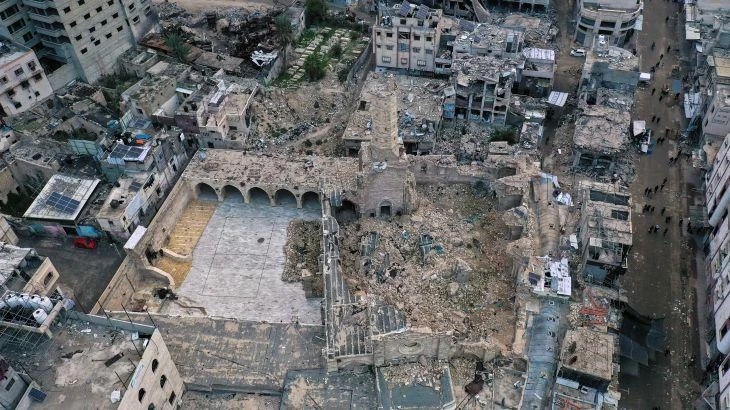
• The Great Omari Mosque (Al-Masjid al-Omari al-Kabir), destroyed by Israeli airstrike on 8 December 2023. The mosque stood on a site of continuous religious use for at least 2,000 years, a Philistine temple to Dagon, a Byzantine church built in 406 CE, a Crusader cathedral, and finally Gaza's largest and oldest mosque. Its 700-year-old library, founded by the Mamluk Sultan Baybars in 1277, originally held more than 20,000 books and manuscripts; only a fraction, including manuscripts in Islamic jurisprudence, hadith, medicine, philosophy, and Sufism, some dating to 920 AH (1514 CE), have been recovered. A volunteer-led initiative under the Eyes on Heritage Foundation, directed by Palestinian researcher Haneen al-Amsi, has salvaged approximately 3,000–4,000 volumes from the rubble.
• The Church of Saint Porphyrius, struck by an Israeli airstrike on 19 October 2023 while sheltering hundreds of civilians. At least 18 Palestinian Christians were killed. Founded in the 5th century CE, it is believed to be the world's third-oldest operating church and the oldest in Gaza. It is the burial place of Saint Porphyrius, 5th-century bishop of Gaza.
• The Saint Hilarion Monastery (Tell Umm ʿAmer), one of the oldest Christian monasteries in the Middle East, founded by Saint Hilarion in the 4th century CE. Excavated by a joint Palestinian-French expedition, it is listed on UNESCO's World Heritage Tentative List and was granted "provisional enhanced protection" by UNESCO in December 2023 under the 1954 Hague Convention. Damage has been documented to parts of the complex.
• The Byzantine Church of Jabaliya (Mukheitim), a 5th-century church with celebrated mosaic floors and Greek inscriptions, restored by Palestinian, French, and Spanish teams with British Council funding before being largely damaged and converted by Israeli forces into a military base.
• The archaeological sites of the coast, Tell es-Sakan, Tell Ruqaish, Tell al-ʿAjul, Tell al-Mintar, Tell Rafah, and Anthedon Harbour (Blakhiyya), Gaza's ancient seaport dating to 800 BCE, another UNESCO Tentative List site. All have sustained severe damage from airstrikes and military activity; Forensic Architecture has documented the impacts at Anthedon.
• The Deir al-Balah site, the location of the 1972–1982 excavations that revealed the famous Philistine anthropoid clay coffins dating to the Late Bronze Age (1550–1200 BCE), has been badly damaged.
• The Al-Qarara Cultural Museum, destroyed by Israeli airstrike early in the conflict. The Rashad al-Shawa Cultural Centre was destroyed by Israeli shelling on 25 November 2023. The Shababeek for Contemporary Art, with a collection of 20,000 artworks, was destroyed in March 2024 during the siege of Al-Shifa Hospital.
• The ʿUmari Mosque of Jabaliya, the Sayed al-Hashim Mosque, the 15th-century Ibn ʿUthman Mosque in Shujaʿiyya (destroyed July 2024), the Katib al-Wilaya Mosque (1334 CE, Mamluk), and the Great Mosque of Khan Younis, all among Gaza's most significant historic religious buildings, have been damaged or destroyed. According to the Palestinian Ministry of Endowments, 79 per cent of Gaza's mosques were destroyed by February 2025, with estimates rising to 89 per cent (1,109 of 1,244 mosques) in later assessments.
• The archive of the École biblique et archéologique française (EBAF) in the Rimal neighbourhood, struck by the Israeli air force on 14 September 2025. Israeli authorities warned EBAF days in advance; an emergency operation rescued some important artefacts, but most of the collection remained in the building.
4.3 Scholasticide: the war on Gaza's universities
The destruction of Gaza's higher education system is perhaps the single most documented example of cultural destruction in the contemporary war. Before October 2023, Gaza, despite a seventeen-year blockade, was home to twelve universities and nineteen higher education institutions, serving approximately 88,000 students with one of the lowest illiteracy rates in the Arab world (1.8 per cent). On 9 October 2023, two days after Hamas's attack on southern Israel, the Israeli military destroyed the library of the Islamic University of Gaza. On 10 October, it bombed the iconic Samir Mansour Bookshop (which had already been destroyed during the 2021 Gaza war and rebuilt with an international crowdfunding campaign). On 11 October, it levelled the main buildings and mosque of the Islamic University of Gaza, a campus serving 20,000 students; Al-Azhar University's main campus and branch in al-Mughraqa were also bombed.
By May 2024, according to the Palestinian Ministry of Higher Education and UNOSAT, all twelve universities in Gaza had been partially or completely destroyed. Israa University, which had been commandeered and used by the Israeli military as a military base and detention facility for months, was demolished in a controlled explosion on 17 January 2024; video of the demolition was uploaded by Israeli media. The library of Al-Aqsa University was filmed being set on fire by Israeli soldiers. In May 2024, a video circulated widely of an Israeli soldier mocking the destruction of Al-Azhar University: "We are at a university in Gaza. If you want to sign up, if you want to learn, I think they're closed for construction. Yes, they're closed for construction. How beautiful."
On 18 April 2024, a group of United Nations experts, including Special Rapporteurs on education, on cultural rights, and on the situation of human rights in the Palestinian territories, issued a joint statement describing the pattern as "scholasticide":
"It may be reasonable to ask if there is an intentional effort to comprehensively destroy the Palestinian education system, an action known as 'scholasticide.'"UN Experts, OHCHR joint statement, 18 April 2024
The human toll has been as devastating as the infrastructural. By early 2024, at least 94 university professors, including three university presidents and seven deans, had been killed (Euro-Mediterranean Human Rights Monitor). By mid-2024, the Palestinian Ministry of Higher Education reported at least 555 university students and more than 100 academics killed. In July 2025, the presidents of Gaza's three non-profit universities, the Islamic University of Gaza, Al-Azhar University–Gaza, and Al-Aqsa University, issued a joint open letter to the international academic community declaring that "at no point in history has a people's educational system been so comprehensively destroyed within such a short timeframe."
4.4 The targeted killing of writers, poets, and academics
Perhaps the most intimate form of cultural destruction has been the killing of individual cultural producers, the writers, poets, academics, journalists, and artists whose work has sustained Palestinian letters. Some cases have become globally known.
Dr. Refaat Alareer, a 44-year-old professor of English literature at the Islamic University of Gaza, a scholar of John Donne, and the editor of Gaza Writes Back (2014) and Gaza Unsilenced (2015), was killed in an Israeli airstrike on his sister's apartment in Shujaʿiyya on 6 December 2023, along with his brother, his sister, and four of her children. In April 2024, an Israeli airstrike on a building of the international NGO Global Communities killed his eldest daughter Shaimaa, her husband, and their two-month-old son, a grandchild Alareer never met. Euro-Med Human Rights Monitor has stated that Alareer was specifically targeted after receiving telephoned death threats. His poem "If I Must Die," written in 2011, has been translated into more than 250 languages since his death and read aloud at ceasefire demonstrations worldwide:
"If I must die, you must live / to tell my story / to sell my things / to buy a piece of cloth / and some strings, (make it white with a long tail) / so that a child, somewhere in Gaza / while looking heaven in the eye / awaiting his dad who left in a blaze, / and bid no one farewell / not even to his flesh / not even to himself, / sees the kite, my kite you made, flying up above, / and thinks for a moment an angel is there / bringing back love."Refaat Alareer, "If I Must Die" (2011)
Heba Abu Nada, a 32-year-old novelist, poet, and biochemist, whose debut novel Oxygen is Not for the Dead (2017) had won the Sharjah Award for Arab Creativity, was killed in an Israeli airstrike on her home in southern Gaza on 20 October 2023, having fled the bombardment of northern Gaza. Her final Facebook post, written on 8 October, has become a testament:
"Gaza's night is dark apart from the glow of rockets, quiet apart from the sound of the bombs, terrifying apart from the comfort of prayer, black apart from the light of the martyrs. Good night, Gaza."Heba Abu Nada, final Facebook post, 8 October 2023
By January 2024, according to TIME magazine's documentation, at least 13 Palestinian poets and 68 journalists had been killed. By December 2024, PEN International's "War on Writers" campaign had catalogued dozens of case files of Palestinian writers, including the novelist and educator Abdul Karim al-Hashash; the 20-year-old writer and musician Yousef Dawas, who wrote for the We Are Not Numbers project Alareer had co-founded; and many more. The Palestinian Ministry of Culture reported in February 2024 that 44 cultural workers had been killed and 200 historic buildings damaged or destroyed; by October 2025, the number of journalists killed had exceeded 200, making the war on Gaza the deadliest conflict for journalists in modern history according to the Committee to Protect Journalists.
5. The Parallel Track: Appropriation of Palestinian Culture
Alongside the destruction of Palestinian cultural property runs a second, equally important process: the appropriation of Palestinian cultural forms into the symbolic repertoire of Israeli national identity. This process has been most exhaustively documented in three domains: embroidery (tatreez), the keffiyeh, and food.
5.1 Tatreez: threads of memory, threads of theft
Tatreez, the Palestinian cross-stitch embroidery that for centuries adorned the thobes (traditional dresses) of village women, is among the most distinctive and coherent visual traditions of the Eastern Mediterranean. Until 1948, each village in Palestine had its own characteristic palette, motifs, and stitches, so much so that a knowledgeable observer could identify a woman's place of origin, marital status, wealth, and family history from the embroidery of her dress (Weir, 1989; Kawar, 2011; Ghnaim, 2018). The cypress tree of Hebron, the orange blossoms of Bayt Dajan, the palm trees of Jaffa, the "Necklace of Gaza" chest panel, the extravagant silver-and-gold threads of Bethlehem wedding attire, each was a specific and legible form of identification.
The British scholar and V&A curator Shelagh Weir, whose Palestinian Costume (British Museum Press, 1989) remains the foundational study in English, demonstrated that Palestinian embroidery constituted a distinct material culture developed over centuries and connected to regional agricultural life. The Jordanian-Palestinian researcher Widad Kawar, whose private collection of more than 2,000 pieces forms the basis of the Tiraz Centre in Amman, and the Palestinian-American researcher Wafa Ghnaim, founder of Tatreez & Tea, have continued this documentation into the present. In 2021, UNESCO inscribed "The art of embroidery in Palestine, practices, skills, knowledge and rituals" on its Representative List of the Intangible Cultural Heritage of Humanity.
After 1948, the material basis of tatreez was transformed. Displacement disrupted the village-based transmission of patterns; dyes and threads became scarce; and the distinctive regional vocabularies began to merge as refugees were concentrated in camps. In the 1960s, the Palestinian women's organisation Inʿash al-Usra, founded by Samiha Khalil in Al-Bireh, and later the PLO's SAMED programme established tatreez workshops in the refugee camps as a source of income and a form of cultural preservation. During the First Intifada (1987–1993), when Israel banned the public display of the Palestinian flag, women began stitching its colours, red, black, white, and green, into their thobes, producing what became known as the "Intifada dress" (Weir, 1989; Kassis, 2020; Farah, 2021).
Parallel to this resistance ran an appropriation. In 1954, Ruth Dayan, wife of Israeli defence minister Moshe Dayan, founded the fashion house Maskit, a state-supported enterprise that, as the Palestinian researcher Tasnim Alwaʿl has documented, employed Arab embroiderers in unequal conditions and rebranded Palestinian motifs as "Israeli ethnic fashion." In 1966, Miss Israel wore a dress embroidered in the distinctive style of Bir al-Sabaʿ (Beersheba) to the Miss Universe pageant, where she won "best national costume." In the 1970s, the Israeli airline El Al adopted dresses incorporating Palestinian embroidery as cabin-crew uniforms. The Rikma fashion house, founded by the Bulgarian-Jewish designer Rozi Ben-Yosef in Tel Aviv, drew heavily on the keffiyeh and on village embroidery motifs. In 2024, Israel's Eretz Israel Museum staged a retrospective exhibition ("Maskit: Designs from the 1960s and 70s") presenting these garments as "vintage Israeli fashion", a categorisation the Palestinian researchers writing for the Tatreez Institute and the Palestinian Museum have contested (Alwaʿl, 2025; Farah, 2021; Kassis, 2020).
5.2 The keffiyeh
The black-and-white keffiyeh, though historically worn across the Arab world, became specifically associated with Palestinian national identity during the Arab Revolt of 1936–1939, when Palestinians across class and religion wore it as a mark of solidarity against British colonial rule. Its symbolic status was reinforced in the post-1948 era and especially during the career of Yasser Arafat, chairman of the PLO, who wore the keffiyeh arranged in the shape of historic Palestine on his shoulder. Today, the Hirbawi factory in Hebron, founded in 1961, is the only factory in Palestine still producing the keffiyeh using its original method (CNN, 2023; Middle East Eye, 2023).
Since the 2000s, global fashion houses have repeatedly produced keffiyeh-inspired garments without cultural attribution. In 2021, Louis Vuitton produced a "keffieh stole" priced at US $705; social-media backlash forced the brand to withdraw the item. In 2017, Topshop pulled a "scarf-print playsuit" based on the keffiyeh pattern. The Palestinian designer Omar Joseph Nasser-Khoury has described such uses as "exploitative": "You have people who were dispossessed in 1948 and made refugees and they still live in camps in Lebanon and then you use this garment, which carries all that pain, for personal advancement." The Palestinian-American scholar Wafa Ghnaim writes that "cultural appropriation leads to cultural erasure" (Ghnaim, interviewed in CNN, 2023).
5.3 Food
The debate over the national origins of hummus, falafel, maqluba, musakhan, zaʿatar, and tabbouleh is among the most public and contentious sites of cultural-ownership dispute in the region. Contemporary scholarship, notably Reem Kassis's The Palestinian Table (Phaidon, 2017) and The Arabesque Table (2021), Sami Tamimi and Tara Wigley's Falastin: A Cookbook (2020), and Joudie Kalla's Palestine on a Plate (2016), has sought to re-locate Palestinian cuisine within its regional and historical context. Serious historical work on the origins of hummus and falafel, by food historians including Charles Perry and Gil Marks, has tended to trace these dishes to medieval Arabic culinary texts and to pre-1948 Levantine practice. The marketing of these dishes as "Israeli cuisine", a genre that did not exist before 1948, has been critiqued both by Palestinian scholars (Safieh, 2025; Kassis, 2020) and by the Israeli-Palestinian chef Sami Tamimi and British-Israeli chef Yotam Ottolenghi, whose collaborative cookbooks explicitly attribute dishes to their Arab origins.
5.4 Restrictions on cultural practice
Parallel to appropriation runs a set of direct legal and infrastructural restrictions on Palestinian cultural practice. Foraging for wild herbs such as zaʿatar (thyme) and ʿakkoub was banned in 1977 by Israel's Ministry of Agriculture as a supposed nature-conservation measure, even though the plants have been harvested by Palestinian communities for centuries; the restriction disproportionately criminalises a specific Palestinian cultural practice (Meneley, 2014; Safieh, 2025). The grazing of black Bedouin goats was restricted by the Israeli "Black Goat Law" until 2018. Fishing in Gaza has been limited to between three and six nautical miles from shore, far below the twenty miles provided under the Oslo Accords, curtailing a livelihood and a culinary tradition central to Gaza's coastal identity.
6. Cultural Resistance: "We Are More Than Buildings"
The survival of Palestinian culture through more than a century of dispossession is one of the remarkable stories of cultural persistence in modern history. Resistance to memoricide has taken multiple forms, each a response to a different register of erasure.
6.1 Oral history and the reclamation of memory
The most sustained intellectual response to memoricide has been the expansion of Palestinian oral history. Building on early work by Rosemary Sayigh (The Palestinians: From Peasants to Revolutionaries, 1979), scholars including Ahmad Sa'di, Lila Abu-Lughod (Nakba: Palestine, 1948, and the Claims of Memory, Columbia University Press, 2007), Rochelle Davis (Palestinian Village Histories: Geographies of the Displaced, Stanford, 2011), Diana Allan (Refugees of the Revolution, Stanford, 2013), and Fatma Kassem (Palestinian Women: Narrative Histories and Gendered Memory, Zed Books, 2011) have positioned oral history as a methodology of decolonisation. The Palestinian Oral History Archive at the American University of Beirut, the Institute for Palestine Studies' Palestine Remembered project (with more than 700 filmed interviews), and Zochrot's testimony archive constitute a vast archive of Palestinian memory developed precisely against the institutional archives from which Palestinian voices have been excluded.
6.2 The Palestinian Museum and digital heritage
The Palestinian Museum in Birzeit, opened in 2016 after eighteen years of planning by the Taawon Welfare Association, is Palestine's most ambitious institutional response to cultural dispossession. Its 2018 exhibition Labour of Love: New Approaches to Palestinian Embroidery, curated by Rachel Dedman, reframed tatreez as a political economy rather than merely a craft. Its digital archive, Palestinian Journeys, developed in partnership with Qatar Foundation, is now one of the most extensive open-access archives of Palestinian history. The Khalil Sakakini Cultural Centre in Ramallah, the Dar El-Nimer for Arts and Culture in Beirut, and the Arab Centre for Research and Policy Studies all provide parallel institutional infrastructure.
6.3 Salvage archaeology and conservation under fire
In Gaza, the Palestinian Ministry of Endowments, the Eyes on Heritage Foundation, and the salvage-archaeology team led by Fadel al-Utol and Haneen al-Amsi have worked, under ongoing bombardment, to recover manuscripts, artefacts, and architectural fragments. The British Council's Cultural Protection Fund supported a £331,488 project beginning in 2020 to conserve and digitise at least 2,400 pages of Islamic manuscripts from the Great Omari Mosque library, in partnership with Cooperazione Internazionale Sud Sud, the Hill Museum & Manuscript Library (HMML), and the British Library's Endangered Archives Programme. Many of the digitised manuscripts now exist only in their digital form, the originals buried or destroyed.
6.4 Poetry, literature, and the living archive
The vitality of Palestinian literature has been, if anything, intensified by erasure. The poetry of Mahmoud Darwish (d. 2008), whose collected work has been translated into more than thirty languages, remains the single most widely read corpus of modern Arab poetry. The poetic generation that has emerged under the blockade and during the current war, Mosab Abu Toha (Things You May Find Hidden in My Ear, 2022; Forest of Noise, 2024), Hala Alyan, Fady Joudah, Najwan Darwish, Basman Aldirawi, Yahya Ashour, has received extensive international recognition. The anthology You Must Live: New Poetry from Palestine, edited by Tayseer Abu Odeh and Sherah Bloor (Copper Canyon Press, 2025), gathers thirty-four poets writing through the current war.
6.5 Tatreez as living tradition
The most remarkable feature of Palestinian cultural resistance may be the degree to which traditional forms have continued to evolve rather than simply be preserved. Tatreez is practised today across the Palestinian diaspora by organisations such as Inaash (Lebanon), Hadeel (Scotland), Sunbula (Jerusalem), the Tatreez & Tea school (USA), the Tatreez Institute (USA), and countless informal groups on Zoom, Instagram, and TikTok. New motifs, incorporating olive branches, keys of return, and references to contemporary events, continue to be created, in a tradition that has never stopped innovating even as it has remembered.
7. International Law and the Protection of Palestinian Cultural Heritage
The destruction of Palestinian cultural heritage implicates multiple treaties to which Israel is bound either directly or through the rules of customary international humanitarian law applicable to occupying powers. The most important are:
• Article 27(4) of the 1907 Hague Regulations, which requires armed forces in siege situations to "take all measures necessary" to spare places of worship and buildings housing artistic, scientific, or charitable institutions.
• The 1948 Genocide Convention, Article II(c) of which prohibits "deliberately inflicting on the group conditions of life calculated to bring about its physical destruction in whole or in part", a provision cited extensively in the January 2024 ICJ application by South Africa.
• The 1949 Fourth Geneva Convention, which regulates the conduct of an occupying power.
• The 1954 Hague Convention for the Protection of Cultural Property in the Event of Armed Conflict and its Second Protocol (1999), to which Israel is a State Party. Article 4 of the Convention requires states to "refrain from any act of hostility directed against such property."
• The 1970 UNESCO Convention on the Means of Prohibiting and Preventing the Illicit Import, Export and Transfer of Ownership of Cultural Property.
• The 1972 UNESCO World Heritage Convention.
• The 2003 UNESCO Declaration Concerning the Intentional Destruction of Cultural Heritage, adopted partly in response to the Taliban's 2001 destruction of the Bamiyan Buddhas.
• The 2003 UNESCO Convention for the Safeguarding of the Intangible Cultural Heritage.
In addition, the Rome Statute of the International Criminal Court, Article 8(2)(b)(ix), defines "intentionally directing attacks against buildings dedicated to religion, education, art, science or charitable purposes, historic monuments, hospitals and places where the sick and wounded are collected, provided they are not military objectives" as a war crime. In 2016, the ICC convicted Ahmad Al Mahdi for the destruction of religious and historic buildings in Timbuktu, establishing a precedent for the prosecution of cultural destruction as a war crime.
7.1 ICJ and ICC proceedings
On 29 December 2023, South Africa filed a case before the International Court of Justice alleging that Israel's conduct in Gaza violated its obligations under the Genocide Convention. Among the evidence cited in the 84-page application was the systematic destruction of educational and cultural infrastructure, including the demolition of Al-Azhar and Israa Universities. In its provisional measures order of 26 January 2024, the Court found it "plausible" that Israel's conduct in Gaza violated the Genocide Convention and ordered Israel to take immediate steps to prevent acts of genocide and to preserve evidence relating to allegations of acts within the scope of the Convention.
On 21 November 2024, the International Criminal Court issued arrest warrants for Israeli Prime Minister Benjamin Netanyahu, former Defence Minister Yoav Gallant, and Hamas military commander Mohammed Deif (later confirmed deceased) for war crimes and crimes against humanity, including the use of starvation as a method of warfare and the targeting of civilian infrastructure.
7.2 The UNESCO problem
Despite these legal frameworks, the institutional response of UNESCO itself has been widely criticised by Palestinian, Israeli, and international scholars. A January 2024 article in the Institute for Palestine Studies' Jerusalem Quarterly (97) documented that UNESCO's initial response to the destruction in Gaza was limited to expressions of "deep concern" and general calls for respect for international law. By contrast, UNESCO's response to the Russian bombing of the Transfiguration Cathedral in Odesa in July 2023 had been a statement of being "deeply dismayed," accompanied by substantial emergency assistance. In December 2023, UNESCO did grant "provisional enhanced protection" to the Saint Hilarion monastery, but broader institutional engagement remained minimal until after the October 2025 ceasefire. In June 2025, the UN Independent International Commission of Inquiry on the Occupied Palestinian Territory concluded that Israeli attacks on schools, religious and cultural sites in Gaza amounted to war crimes, stating: "Israel has obliterated Gaza's education system and destroyed more than half of all religious and cultural sites in Gaza."
8. Conclusion: Culture and the Question of Survival
The destruction of Palestinian cultural heritage is neither collateral damage nor an unfortunate byproduct of a military conflict. As this paper has documented, it is the most visible expression of a structural project of erasure that has unfolded over more than seventy-five years across multiple registers: the physical demolition of villages, mosques, churches, schools, and archaeological sites; the looting of libraries and archives; the Hebraisation of place names and the afforestation of ruins; the bombardment and demolition of every university in Gaza; the targeted killing of poets, professors, journalists, and artists; the appropriation of Palestinian dress, food, and symbols into a settler-colonial national iconography; and the legal restriction of Palestinian cultural practices such as foraging and fishing.
What is striking is that this process has been documented, in unprecedented detail, by the very institutions, UNESCO, the ICJ, the UN Human Rights Council, the Palestinian Ministry of Tourism and Antiquities, the Euro-Mediterranean Human Rights Monitor, Blue Shield International, and dozens of academic teams, that are charged with protecting cultural heritage in times of armed conflict. The gap between documentation and enforcement is not an accident of international law but one of its structural features: legal protection for cultural heritage in wartime presupposes a functioning system of international accountability, which, for Palestine, has been blocked repeatedly by political interference and by the veto power of permanent members of the UN Security Council.
What is equally striking, and more hopeful, is that Palestinian culture has not been erased. The survival of tatreez, the continued production of poetry and literature of extraordinary range and quality, the persistence of oral history, the scholarly labour of Palestinian and international historians in reconstructing what was lost, the salvage archaeology being carried out amid ongoing bombardment, the global wearing of the keffiyeh as a sign of solidarity, the UNESCO inscription of Palestinian embroidery, the opening of the Palestinian Museum, and the continued existence of Palestinian universities (in reduced and damaged form, and increasingly online), all testify to what the French historian Pierre Nora called lieux de mémoire, sites of memory, that refuse to disappear even when their physical supports are destroyed.
The Palestinian writer Ghassan Kanafani (assassinated in Beirut in 1972), the poet Mahmoud Darwish (exiled and finally allowed to return only to die), the sociologist Edward Said (writing from the American diaspora of the homeland he could not live in), the novelist Adania Shibli, the historian Rashid Khalidi, the archivist Nur Masalha, and the generation of Gazan writers whose names have joined theirs since October 2023, Refaat Alareer, Heba Abu Nada, Yousef Dawas, Abdul Karim al-Hashash, constitute a tradition that has not been broken and cannot easily be broken. "We are more than buildings," wrote the presidents of Gaza's three non-profit universities in July 2025. "We are academic communities, comprised of students, faculty, and staff, still alive and determined to carry forward our mission."
That sentence, written in a strip of land where every university has been destroyed, is itself the most honest answer to the question with which this paper began. The war on Palestinian culture has been extensive, sustained, and deliberate. It has also, at every stage, failed to extinguish what it sought to extinguish. What remains, in Palestinian libraries rebuilt from rubble, in Wikipedia editing campaigns that re-Arabise place names, in the digitised manuscripts of the Omari Mosque, in a tatreez pattern stitched by a displaced woman in a Khan Younis tent, in a poem read from a stage in São Paulo, in a classroom held over WhatsApp, is the cultural survival of a people. The task of scholarship, and of international institutions, is not to predict whether this survival will continue; it is to ensure that those who would extinguish it are held accountable under the laws they have agreed to uphold.
References
Books and monographs
Abu-Lughod, L. and Sa'di, A. H. (eds.) (2007). Nakba: Palestine, 1948, and the Claims of Memory. New York: Columbia University Press.
Abu Sitta, S. (2000). The Palestinian Nakba 1948: The Register of Depopulated Localities in Palestine. London: Palestinian Return Centre.
Allan, D. (2013). Refugees of the Revolution: Experiences of Palestinian Exile. Stanford: Stanford University Press.
Amit, G. (2014). Ex-Libris: Chronicles of Theft, Preservation, and Appropriating at the Jewish National Library. Jerusalem: Van Leer Institute Press. (In Hebrew.)
Barakat, R. (forthcoming). Lifta and the Nakba of the Palestinian Imagination.
Benvenisti, M. (2000). Sacred Landscape: The Buried History of the Holy Land Since 1948. Berkeley: University of California Press.
Davidson, L. (2012). Cultural Genocide. New Brunswick, NJ: Rutgers University Press.
Davis, R. (2011). Palestinian Village Histories: Geographies of the Displaced. Stanford: Stanford University Press.
Doumani, B. (1995). Rediscovering Palestine: Merchants and Peasants in Jabal Nablus, 1700–1900. Berkeley: University of California Press.
Flapan, S. (1987). The Birth of Israel: Myths and Realities. New York: Pantheon.
Ghnaim, W. (2018). Tatreez and Tea: Embroidery and Storytelling in the Palestinian Diaspora. Portland, OR: Tatreez & Tea.
Graham, S. (2010). Cities Under Siege: The New Military Urbanism. London: Verso.
Kalla, J. (2016). Palestine on a Plate: Memories from My Mother's Kitchen. London: Jacqui Small.
Karmi, G. (2002). In Search of Fatima: A Palestinian Story. London: Verso.
Kassem, F. (2011). Palestinian Women: Narrative Histories and Gendered Memory. London: Zed Books.
Kassis, R. (2017). The Palestinian Table. London: Phaidon.
Kassis, R. (2021). The Arabesque Table. London: Phaidon.
Kawar, W. (2011). Threads of Identity: Preserving Palestinian Costume and Heritage. Nicosia: Rimal Publications.
Khalidi, R. (1997). Palestinian Identity: The Construction of Modern National Consciousness. New York: Columbia University Press.
Khalidi, R. (2020). The Hundred Years' War on Palestine: A History of Settler Colonialism and Resistance, 1917–2017. New York: Metropolitan Books.
Khalidi, W. (ed.) (1992). All That Remains: The Palestinian Villages Occupied and Depopulated by Israel in 1948. Washington, DC: Institute for Palestine Studies.
Lemkin, R. (1944). Axis Rule in Occupied Europe: Laws of Occupation, Analysis of Government, Proposals for Redress. Washington, DC: Carnegie Endowment for International Peace.
Masalha, N. (1992). Expulsion of the Palestinians: The Concept of "Transfer" in Zionist Political Thought, 1882–1948. Washington, DC: Institute for Palestine Studies.
Masalha, N. (2007). The Bible and Zionism: Invented Tradition, Archaeology and Post-Colonialism in Israel-Palestine. London: Zed Books.
Masalha, N. (2012). The Palestine Nakba: Decolonising History, Narrating the Subaltern, Reclaiming Memory. London: Zed Books.
Masalha, N. (2018). Palestine: A Four Thousand Year History. London: Zed Books.
Morris, B. (2004). The Birth of the Palestinian Refugee Problem Revisited. Cambridge: Cambridge University Press.
Nabulsi, K. (1999). Traditions of War: Occupation, Resistance and the Law. Oxford: Oxford University Press.
Pappé, I. (2006). The Ethnic Cleansing of Palestine. Oxford: Oneworld.
Pappé, I. (2017). Ten Myths about Israel. London: Verso.
Porteous, J. D. and Smith, S. E. (2001). Domicide: The Global Destruction of Home. Montreal: McGill-Queen's University Press.
Sabbagh-Khoury, A. (2023). Colonizing Palestine: The Zionist Left and the Making of the Palestinian Nakba. Stanford: Stanford University Press.
Said, E. (1986). After the Last Sky: Palestinian Lives. London: Faber & Faber.
Sayigh, R. (1979). The Palestinians: From Peasants to Revolutionaries. London: Zed Books.
Shehadeh, R. (2007). Palestinian Walks: Notes on a Vanishing Landscape. London: Profile Books.
Shlaim, A. (2000). The Iron Wall: Israel and the Arab World. New York: W. W. Norton.
Short, D. (2016). Redefining Genocide: Settler Colonialism, Social Death and Ecocide. London: Zed Books.
Tamimi, S. and Wigley, T. (2020). Falastin: A Cookbook. London: Ebury Press.
Weir, S. (1989). Palestinian Costume. London: British Museum Press.
Journal articles and book chapters
Abd al-Jawad, S. (2007). "Zionist Massacres: The Creation of the Palestinian Refugee Problem in the 1948 War." In Eyal Benvenisti, Chaim Gans and Sari Hanafi (eds.), Israel and the Palestinian Refugees, Heidelberg: Springer, pp. 59–127.
Alareer, R. (2011). "If I Must Die." Poem widely disseminated online; republished in R. Alareer (ed.), Gaza Writes Back (2014) and posthumously in If I Must Die: Poetry and Prose (Or Books, 2024).
Amit, G. (2008). "Salvage or Plunder? Israel's "Collection" of Private Palestinian Libraries in West Jerusalem." Journal of Palestine Studies, 40(4), 6–23.
Hanafi, S. (2012). "Explaining Spacio-cide in the Palestinian Territory: Colonization, Separation, and State of Exception." Current Sociology, 61(2), 190–205.
Khalidi, W. (1988). "Plan Dalet: Master Plan for the Conquest of Palestine." Journal of Palestine Studies, 18(1), 4–33.
Khoury, E. (2012). "Rethinking the Nakba." Critical Inquiry, 38(2), 250–266.
Masalha, N. (2015). "Settler-Colonialism, Memoricide and Indigenous Toponymic Memory: The Appropriation of Palestinian Place Names by the Israeli State." Journal of Holy Land and Palestine Studies, 14(1), 3–57.
Nijim, M. (2023). "Genocide in Palestine: Gaza as a Case Study." International Journal of Human Rights, 27(1), 165–200.
Rashed, H., Short, D. and Docker, J. (2014). "Nakba Memoricide: Genocide Studies and the Zionist/Israeli Genocide of Palestine." Holy Land Studies, 13(1), 1–23.
Wolfe, P. (2006). "Settler Colonialism and the Elimination of the Native." Journal of Genocide Research, 8(4), 387–409.
Farah, R. (2021). "The Responsibility to Palestinian Tatreez." Third Text Online.
Alwaʿl, T. (2025). "Stolen Threads: The Appropriation of Palestinian Embroidery by Israeli Designers." Tatreez Institute Journal, May.
Meneley, A. (2014). "Resistance is Fertile!" Gastronomica: The Journal of Food and Culture, 14(4), 69–78.
Safieh, D. (2025). "Preserving Identity: How Palestinians Protect and Celebrate Their Heritage in the Face of Erasure." Washington Report on Middle East Affairs, 44(2), 62–63.
Reports, institutional documents, and documentary films
Al Mezan Center for Human Rights (2024). "Scholasticide: Israel's Deliberate and Systematic Destruction of the Palestinian Education System in Gaza." Gaza: Al Mezan, September 2024.
Brunner, B. (dir.) (2012). The Great Book Robbery: Chronicles of a Cultural Destruction. Xela Films / Al Jazeera English. 48 minutes.
Committee to Protect Journalists (2024–2025). "Journalist Casualties in the Israel-Gaza War." Ongoing database.
Euro-Mediterranean Human Rights Monitor (2024). "Annihilation of Gaza Education: Israel is Systematically Erasing the Entire Educational System." Geneva: Euro-Med HRM.
Institute for Palestine Studies (2024). "Destruction of Cultural Heritage in Gaza." Jerusalem Quarterly, 97.
International Court of Justice (2024). Application of the Convention on the Prevention and Punishment of the Crime of Genocide in the Gaza Strip (South Africa v. Israel). Order of 26 January 2024.
International Criminal Court (2024). Arrest warrants in the Situation in the State of Palestine, 21 November 2024.
Jones, R. L. (dir.) (2002). 500 Dunam on the Moon. Documentary film, 48 minutes.
PEN International (2024). "War on Writers: Honoring Palestinian Writers Lost in the Gaza Conflict." London: PEN International.
UN Independent International Commission of Inquiry on the Occupied Palestinian Territory (2025). Report A/HRC/59/CRP.3, June 2025.
UN OHCHR (2024). Joint statement by UN experts: "Scholasticide Must Stop: UN Experts Appalled by Destruction of Educational Infrastructure in Gaza." 18 April 2024.
UNESCO (2024–2026). "Damage Assessment for Cultural Properties in the Gaza Strip." Ongoing remote and on-site assessment.
UNESCO (2021). Inscription on the Representative List of the Intangible Cultural Heritage of Humanity: "The art of embroidery in Palestine, practices, skills, knowledge and rituals."
UNOSAT (2024). "Gaza Strip Comprehensive Damage Assessment." UN Satellite Centre, April 2024.
World Bank (2024). Gaza Strip: Interim Damage Assessment. Washington, DC, March 2024.
Albanese, F. (2024). "Anatomy of a Genocide." Report of the Special Rapporteur on the situation of human rights in the Palestinian territories occupied since 1967. UN document A/HRC/55/73, 1 July 2024.
Key journalism and testimony
+972 Magazine (2024). "The Decimation of Gaza's Academia is 'Impossible to Quantify.'" July 2024.
Al Jazeera (2013). "Israel's 'Great Book Robbery' Unravelled." 29 January 2013.
Al Jazeera (2024). "How Israel has Destroyed Gaza's Schools and Universities." 24 January 2024.
CNN (2023). "The Palestinian Keffiyeh Explained: How This Scarf Became a National Symbol." 28 November 2023.
The Electronic Intifada (2017). "The Great Book Robbery of 1948." 12 February 2017.
The Guardian (2024). Various reports on the destruction of Gaza's cultural heritage, 2023–2026.
Lit Hub (2024). "These Are the Poets and Writers Who Have Been Killed in Gaza." April 2024.
Middle East Monitor (2024). "Discover the Great Omari Mosque, Palestine." 8 January 2024.
Mondoweiss (2010). "The Nakba and the 'Great Book Robbery' of 1948." 25 October 2010.
The New York Times (2024). Coverage of the destruction of the Great Omari Mosque and other cultural sites.
PBS News (2025/2026). "Artists Hope to Preserve and Rebuild Gaza's Cultural Heritage." CANVAS series.
TIME (2024). "How Poetry Became a Tool of Resistance for Palestinians." 11 January 2024.